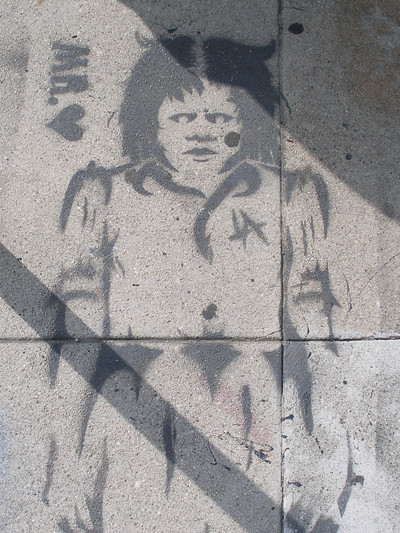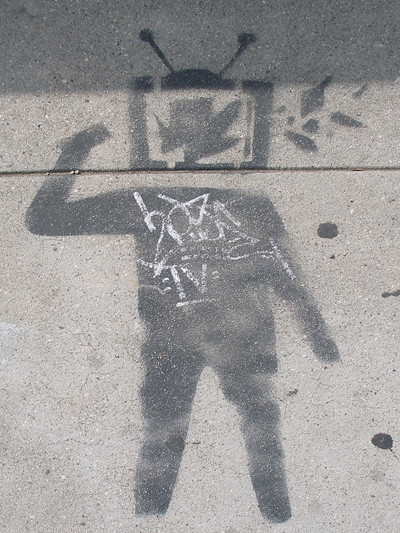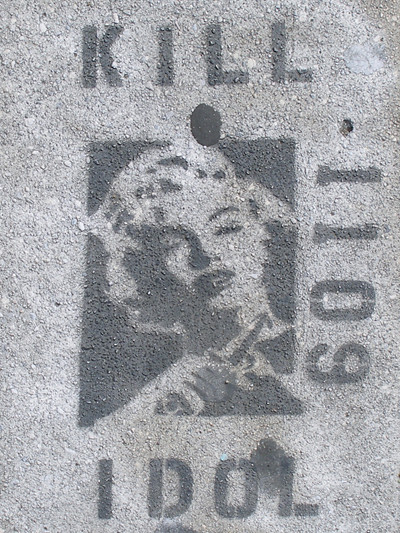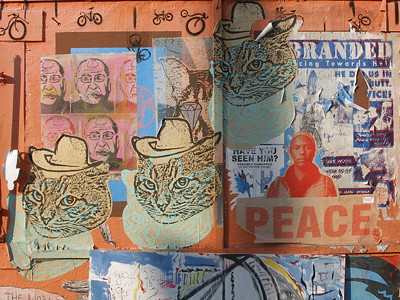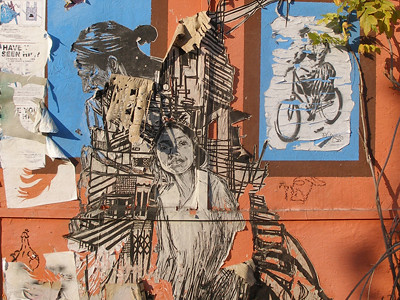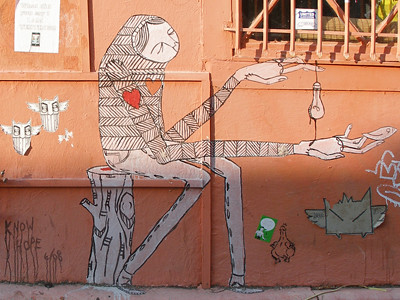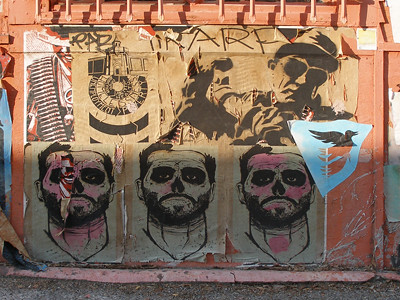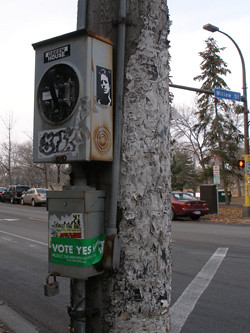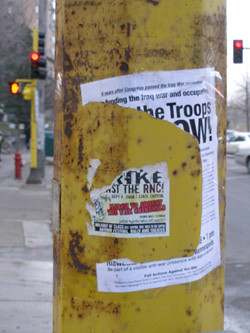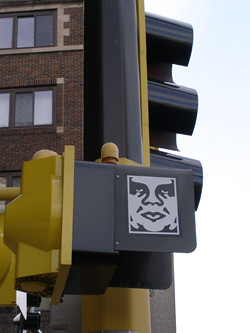
Jamming signals. Radio. Television. This is the etiology of culture jamming. But everything in our information saturated world is ripe for jamming. Culture. Constructs. Assumptions. Images. Introduce a different color of noise into the system. Tool of revolutionaries, but better yet, tool of counter-revolutionaries. Pun. Play. Invert image. Invert meaning. Deeper truth through absurd juxtapositions. Subliminal sandwiches.
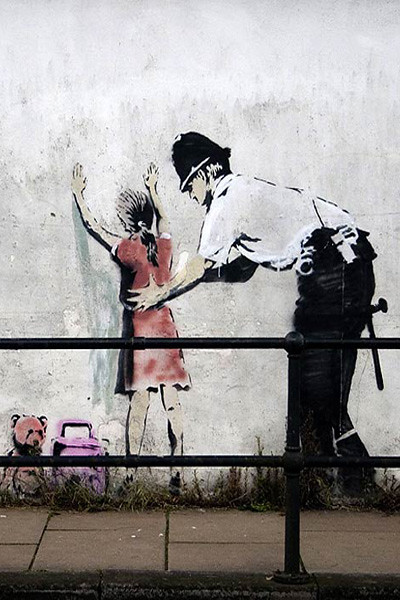
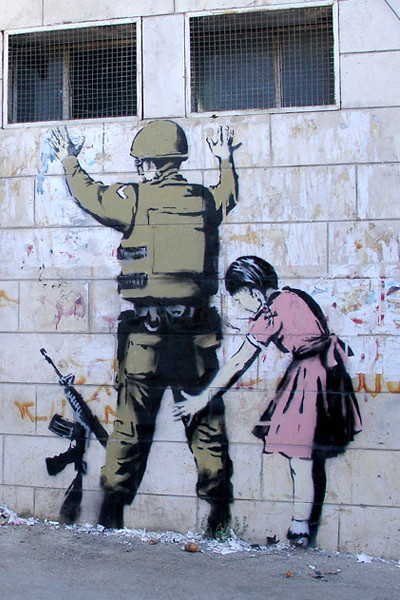
Presumably in London, I'm not quite sure where these two works from Bansky are, or if they're in any spatial or temporal relationship with one another. They're both inversions. The cop frisking the necessarily darling girl, replete with teddy bear inverts notions of the police being guardians of peace into being robbers of peace. In the second picture, the girl then turns the tables on the soldier and exerts power and authority over him.
In the second half of the 20th century, institutional structures were deemed oppressive. They were subverted and dismantled. Then in their place, and supposedly as a remedy, new institutional structures were erected. These were often just as oppressive. Culture councils that wreck and homogenize culture. Human rights tribunals that take away human rights. Policies of choice that destroy choice. It's time to turn that inversion on its head.
Artist Draws 'Clean' Graffiti from Dirty Walls, which reminds me of a time when I sprayed the perpetually half-clothed, shoeless, grubby neighbor kid with the garden hose. His grandmother came running out of their house screeching, "Don't get clean spots on him. I'll have to wash the whole kid."
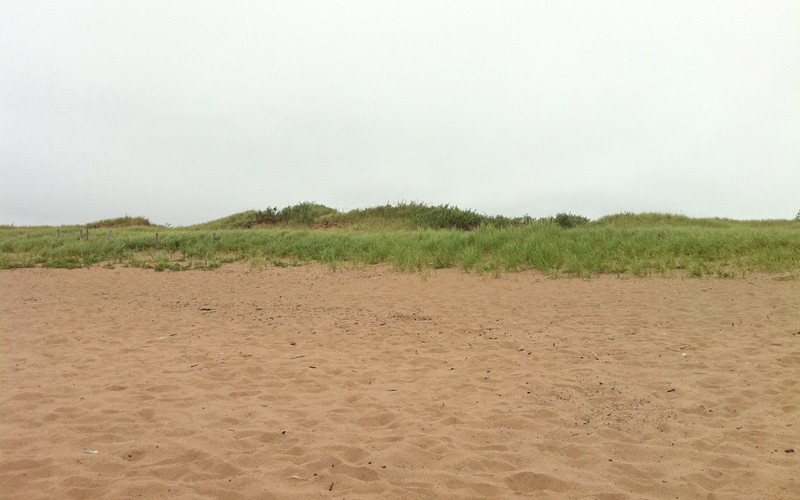
standing on the beach
with a gun in my hand
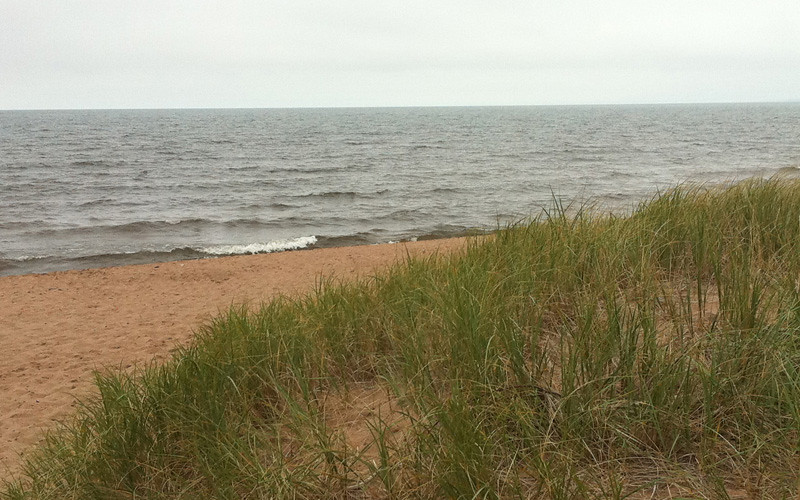
staring at the sea
staring at the sand
staring down the barrel
at the Arab on the ground
I see his open mouth
but I hear no sound
I'm alive...I'm dead
Part I: what a strange man
Meursault, schizoid personality, misanthrope? No, perhaps not, he's a stranger to this world. He's totally honest, cordial, a hard worker, and not at all devoid of virtue. His ways and motives are not the same as what's deemed or conditioned as normal or expected.
Meursault seems limited largely to his sense perception, and operates daily (and in his usually fond memories) on the level of how things taste, smell, look, sound, or feel to him. He seems to take these things as well as relationships quite simply as they are without interpretation, attaching any additional significance, or deriving any particular or expected meaning from them. Meursault can also find himself oppressed by his senses at times. Too much wine, bright sunlight, and heat in particular can prove difficult.
Meursault's neighbor Salamano beat and cursed his scabby old dog for years, but when the dog disappeared, Salamano was concerned of his whereabouts, and he wept. Meursault did not beat or curse his mother, and further acknowledged that he did love her, but when she died, Meursault didn't want to view her body, nor did he grieve. People called Salamano's relationship with his dog pitiful, but he is to be exonerated for his grief. Meursault had no judgement or feeling on the matter; he merely observed the sights and sounds of the situation. Meursault also had no particular judgement or feeling on his mother's death; he merely observed the sensory input of the vigil, procession, and funeral Mass.
I can turn and walk away
or I can fire the gun
staring at the sky
staring at the sun
whichever I chose
it amounts to the same
absolutely nothing
I'm alive...I'm dead
Part II: what a strange world
But that abstraction known as the French People convicted Meursault for the lack of grief over his mother's death, even though his crime was killing an Arab man on the beach.
From right after the killing, there was no doubt of Meursault's guilt; he confessed; his attorney plead guilty. Yet the resulting investigation and court trial were an object lesson in theater of the absurd, and Meursault observed that, "In a way, they seemed to be arguing the case as if it had nothing to do with me." Nor did the proceedings seem to have anything to do with the man whom he had shot.
Meursault is put on trial for all manner of things. Drinking coffee and smoking a cigarette during his mother's vigil. Not crying during her funeral. Premarital sex. Being intelligent. Not having a soul, which somehow the prosecutor contends also implicates him in another murder case going on at the same time...an odious patricide. Everything but the dead man on the beach. Ultimately he's tried and condemned for not attaching the same interpretations, significance, meaning, and emotions to things as others do. Sentence: his head.
I feel the steel butt jump
smooth in my hand
staring at the sea
staring at the sand
staring at myself
reflected in the eyes
of the dead man on the beach
(the dead man on the beach)
I'm alive...I'm dead
Redux
In The Stranger, Camus explored what he called the nakedness of man when faced with the absurd. If you find philosophical absurdism (or its cousins existentialism and nihilism) lacking, don't fret. One can still learn from Meursault even if his radical simplicity is a path far more than one could ever be capable of taking.
We need to learn that things are as they are, which is not always the same as the interpretation, significance, meaning, or emotions attached to them. Perhaps too, we'll need to accept the injustice of men for our non-attachment. Nonessentials are frequently decreed as essentials in religion, science, culture, society, and relationships. We're constantly being required to offer a pinch of incense at the altar of the accepted meaning of these things, and these are jealous gods.
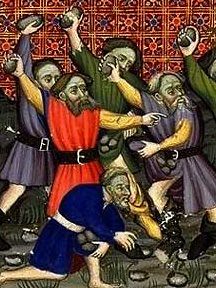
1st Century Palestine |
Casting Stones
Casting Aspersions
Casting Couches
|
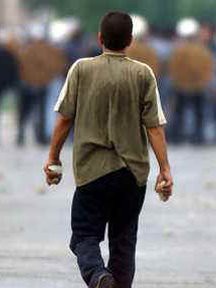
21st Century Palestine |
Stephen intercede for the red martyrs, white martyrs, and pseudo-martyrs.
Stephen intercede for the parish which bears your name.
Our world abounds with anti-concepts. They manufacture opinion; they manufacture consent. They are rhetorical smoke and mirrors calling out pay no attention to the man behind the curtain. Find them. Uproot them.
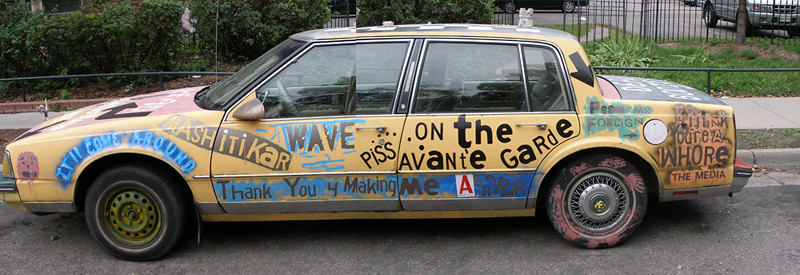
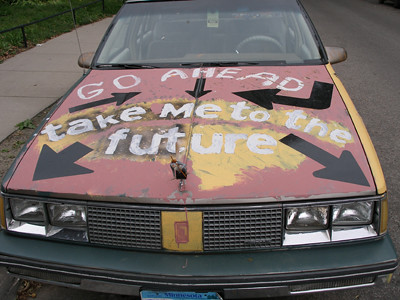
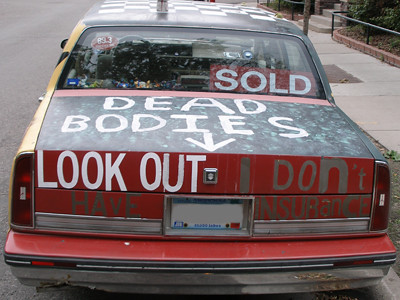
art car: n. a drivable vehicle that has been adorned, painted and/or modified to express some sort of artistic expression. These are usually cars that are covered with anything from beads and mirrors to toys and doll parts, but are only limited by the creator's imagination. See also mutant vehicle.
just: adv.
1. only, simply
2. flag word, that often indicates that was follows is not only or simply as stated
3. a rhetorical marker that deceives or conditions the listener as well as the speaker as to the simplicity of its object